Justice in Community

About Justice in Community
The United States is the wealthiest country in the world, but still struggles with robust injustices that manifest themselves in communities across the nation. For example, 36.8 million people lived in poverty in 2023; approximately 600,000 people were experiencing homelessness in 2022; and 47.4 million people, including 841,000 children, lived in food-insecure households in 2023.
These injustices and others threaten the economic wellbeing of families specifically and communities broadly. The intersecting challenges of sustainable, living wage employment; rising housing costs; and food insecurity, among other barriers, can breed desperation, driving some people into the criminal legal system. Additionally, state governments across the U.S. spend an aggregate of over $64 billion annually to incarcerate people, diverting taxpayer dollars from vital services and infrastructure. This means that finding lasting solutions to these issues is critical to not only make our communities safer and more resilient, but to help them thrive overall.
The Opportunity Youth Forum (OYF) Justice in Community work exists to address these challenges in meaningful and lasting ways by supporting communities as they create spaces in which all members can thrive. We do this by connecting communities, organizations, and individuals that are impacted by, and working within, different justice systems for learning, cross-collaboration, and knowledge-sharing; channeling funding to support organizations and communities as they address systemic issues that serve as barriers to the actualization of justice; and uplifting stories and narratives that highlight the nuances of justice, amplify the voices of those who have been historically ignored, and explore sustainable solutions to create a more just world.
Because of the intersectional nature of this work, we use justice as an inclusive and expansive term. Justice does not prioritize any one demographic or issue, but supports the full continuum of community resilience, wellbeing, security, and opportunity.
Our Work
Our goal is to address the upstream factors that can influence or drive individuals to involvement with the criminal legal system, such as inability to access jobs that pay living wages and promising employment pathways; lack of access to safe, affordable housing; lack of access to all types of healthcare, and lack of access to quality education. This means ensuring that communities and the organizations that support them have the funding, access to knowledge, and infrastructure to reduce contact with the criminal legal system through addressing poverty and its attendant issues, improving community resilience, and reaching marginalized community members early on.
Our vision is a world in which communities have the infrastructure – including safe and affordable housing, access to quality and culturally relevant healthcare, quality education, and more – that will allow them to thrive and, by extension, limit involvement with the criminal legal system.
Our Strategies
To help deliver on our vision, the OYF Justice in Community Program employs the following strategies:
We fund place-based community organizations to effectively respond to known needs in response to local context: Communities know what they need and how best to deploy resources. Currently, our Justice Innovation and Collaboration Fund (Justice ICF) seeks to increase the ability of communities to reach system-impacted, system-involved, and/or system-vulnerable youth before socioeconomic factors lead them to actions that will involve them deeply in the criminal legal system. The Justice ICF provides 12-month awards to support the creation or scaling of place-based strategies determined by and for local communities. This work ultimately aims to document transferable and scalable solutions in reducing the number of youth and young adults involved in all aspects of the criminal legal system – carceral, probation, parole, and more – by empowering community youth and increasing community safety. In the future, we plan to expand beyond a youth focus to fund other community strategies.
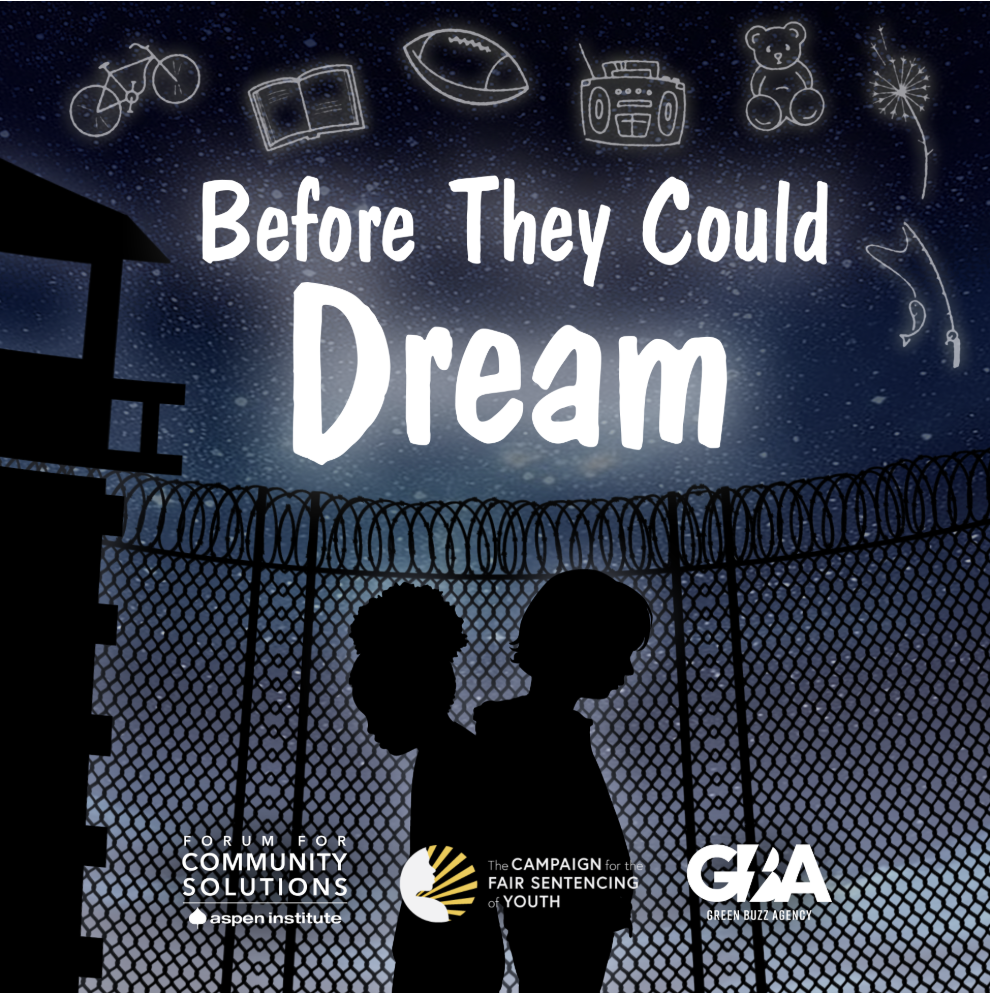
We amplify narratives that center the voices of communities and individuals sharing nuanced stories about, and solutions for, how systemic issues impact them: Storytelling allows us to move away from the general and shed light on personal experiences of the criminal legal system and the people and communities impacted by it. In partnership with the Campaign for the Fair Sentencing of Youth (CFSY) and Green Buzz Agency, the Aspen FCS Justice in Community Program created “Before They Could Dream,” a narrative podcast that explores youth incarceration through the stories of six people who were sentenced to long prison sentences, up to and including life without the possibility of parole, prior to their 18th birthdays. The podcast provides a place for learning, humanizing, reckoning, and memory, as well as a way to shed light on the individual impacts of our system. Moving forward, we aim to help tell broader community stories as well in order to ultimately lay the groundwork for narrative and systems change.
We provide expert guidance, technical assistance, and thought leadership to nonprofits engaged in work that seeks to remedy various injustices and connect them in order to learn from each other: While individual communities know how to solve their own challenges, sharing the burdens and the wins is critical for long-term success. Our Justice community of practice (COP) is a cohort of more than 20 local and national nonprofit organizations engaged in work with, and on behalf of, opportunity youth and vulnerable communities. The Justice COP engages in deep intra-community learning, cross-collaboration, and innovation through a robust learning agenda that includes monthly virtual meetings, biannual in-person meetings during the AFCS’ Opportunity Youth Forum (OYF) convenings, and regular participation in and support of member programming. Beyond the OYF, we plan to include organizations and work that take on even more expansive aspects of justice in their communities.

Locations
Connect Locally
Find an opportunity youth collaborative near you. Opportunity youth are young people between the ages of 16 and 24 who are neither enrolled in school nor participating in the labor market – about 6 million young people in the United States.
Map Key
- Place-Based Collaborative
- Statewide Network
| Initiative | State | Location | Organization | Partner |
|---|---|---|---|---|
| Justice in Community | Alabama | Birmingham | Birmingham Promise | Birmingham Promise |
| Justice in Community | Maine | Portland | Catherine Cutler Institute, University of Southern Maine | Young People's Caucus |
| Justice in Community | New York | Buffalo | Community Foundation of Greater Buffalo (CFGB) | Community Foundation of Greater Buffalo (CFGB) |
| Justice in Community | Texas | Dallas | Janie's Angels | Janie's Angels |
| Justice in Community | Mississippi | Greenville | Local Initiatives Support Corporation | Local Initiatives Support Corporation |
| Justice in Community , Belonging, Meaning, Wellbeing & Purpose , OY Place-Based Partnerships | Hawaii | Honolulu | Partners in Development Foundation | Partners in Development Foundation |
| Justice in Community | Illinois | Chicago | Precious Blood Ministry of Reconciliation | Precious Blood Ministry of Reconciliation |
No members match your current filters.