Opportunity Youth Forum Communities Create $1.2 Billion in Cost Savings Each Year
There are currently over four million opportunity youth in the United States, and nearly one million live in communities supported by the Aspen Institute’s Opportunity Youth Forum (OYF). One in nine young people are ‘opportunity youth’: 16-24 year olds who are currently not engaged in education and not working. In 2024, 900 OYF partner organizations engaged in over 40 local youth-focused place-based partnerships across the United States served over 230,000 youth, and helped 23,000 formerly disconnected young adults attain high school and college degrees or attain jobs.
Using new data and updated techniques to estimate the cost benefits of re-connecting young adults to education and workforce, OYF assessment and data partner Equal Measure has created a new summary on the economic impacts of the 40+ local community collaboratives that are a part of the OYF. Among the key highlights are:
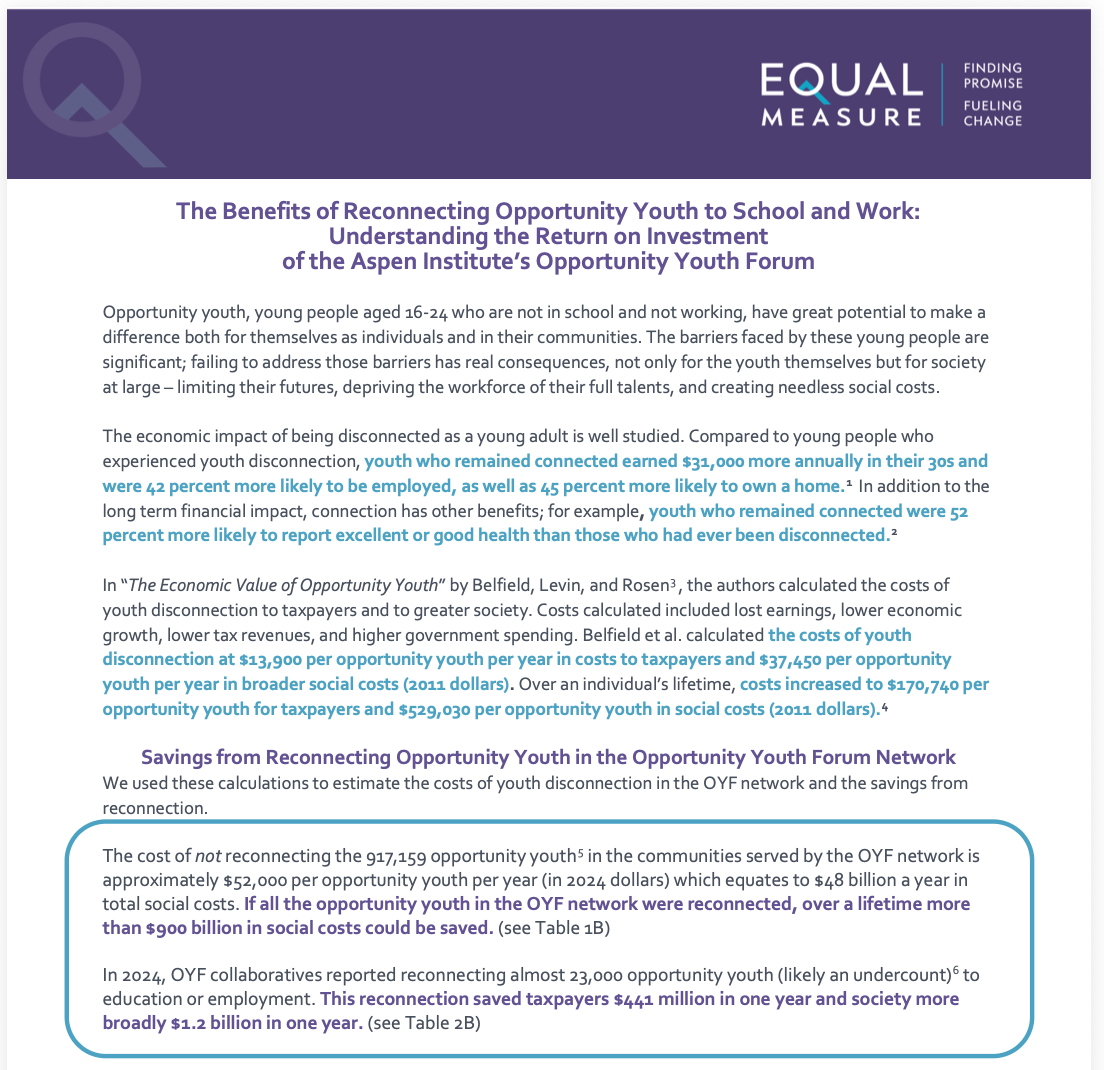
- In 2024, the reconnection of 23,000 opportunity youth across OYF communities to education or employment saved $1.2 billion in one year.
- The lifetime cost savings of reconnecting these 23,000 young people from that single year is estimated to be $22.7 billion.
But there’s more to this story. OYF communities and their partners could be doing much more, if more resources were available. The cost of not helping these young people connect to education and work is staggering:
- The cost of not reconnecting the nearly one million opportunity youth in OYF communities served by the OYF network is $50 billion per year.
- If all one million opportunity youth in the OYF network were reconnected, over a lifetime, more than $950 billion in costs could be saved.
As outlined in their research summary, The Benefits of Reconnecting Opportunity Youth to School and Work, the return on investment from helping young adults to reconnect and/or stay connected to education and work is tremendous. Foundational research by Belfield, Levin and Rosen (“The Economic Value of Opportunity Youth”) from 2012 compared longitudinal data between connected and disconnected youth. When adjusted for inflation, their analysis reveals that connecting a single young person to work or education saves at least $37,000 in annual taxpayer and/or other social costs. The actual savings reported here are likely much higher, as the original Belfield analysis does not cover all possible costs. Additionally, the data that OYF collects from local partners is also an undercount, as not all sites nor all partners are yet able to report complete data to OYF. Together, these factors lead us to believe that the figures reported here are conservative estimates.
The OYF believes that while financial returns are not the only benefits of connecting young people to work and education, they offer a compelling reason for increased public attention and investment. By funding targeted interventions that help young people stay connected to education and work, we can help young people stay engaged in school and work and build a robust pathway to reconnect those who have become disconnected from these systems.
All young people deserve opportunities to thrive and advance their educational and career goals. Public investment in young adults at the local, state, and federal levels supports individual success while helping secure a stronger future for today’s communities and generations to come.
Read The Benefits of Reconnecting Opportunity Youth to School and Work research report.